Steam Frame vs Bigscreen Beyond 2: Which VR Headset Should You Buy?
Steam Frame vs Bigscreen Beyond 2 and 2e: displays, tracking, PC needs, weight, what's in the box and every price, from Valve's and Bigscreen's own pages.
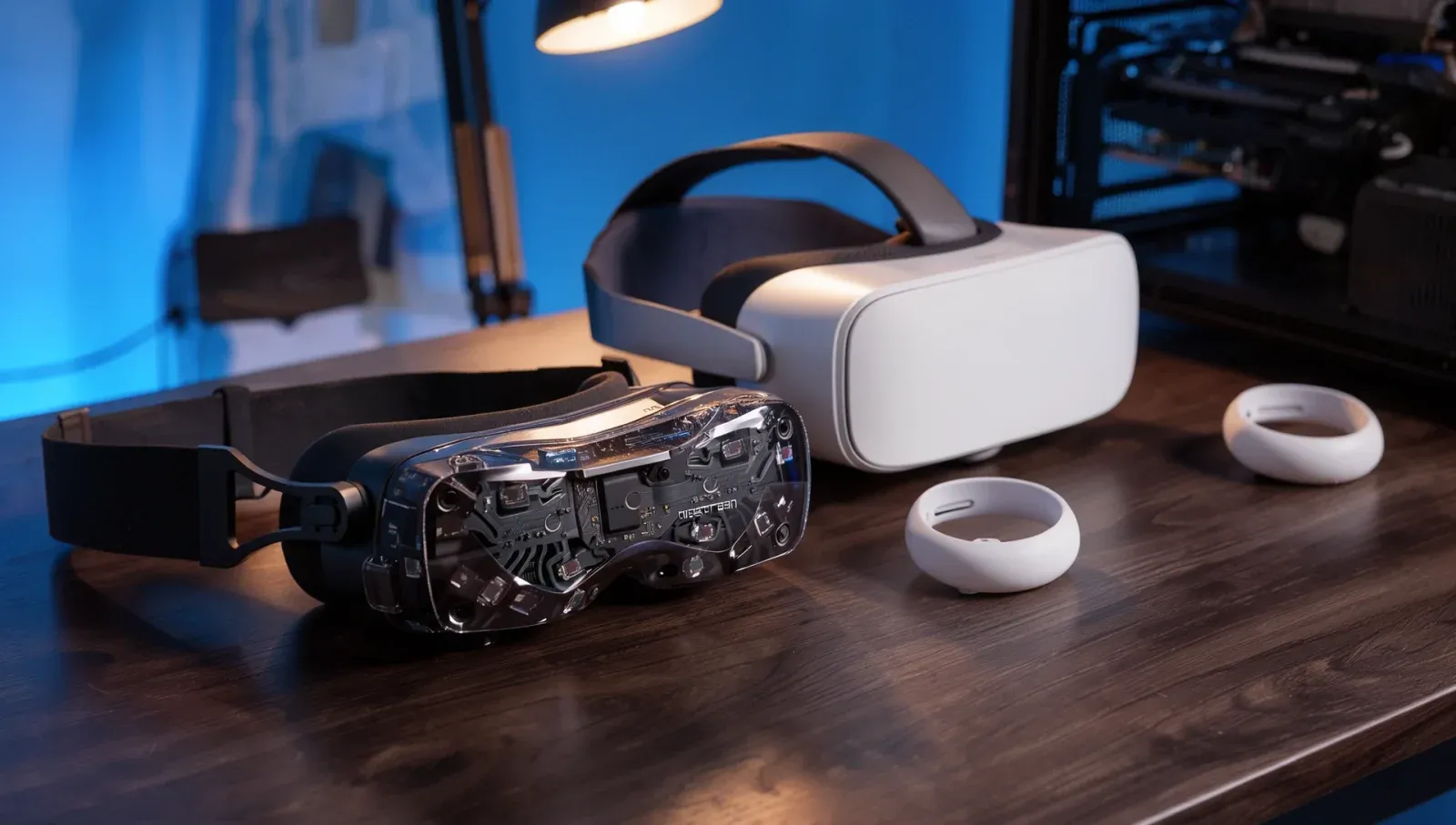
The Steam Frame and the Bigscreen Beyond 2 are built for different people. Valve's Steam Frame is a wireless, all-in-one headset: it tracks itself with cameras, comes with controllers, streams games from your PC and can also run games on its own, from $1,059. The Bigscreen Beyond 2 is a tiny 107g headset with sharper micro-OLED screens, but it is tethered to a Windows PC and needs SteamVR base stations (and usually controllers) that aren't in the box; the headset starts at $959 before the facial interface you have to pick. If you want to play without setup, the Frame. If you already own base stations and want the lightest, sharpest PC VR headset, the Beyond 2. Here's the detail, from Valve's and Bigscreen's own pages.
What do they cost?
Steam Frame (Valve's launch post, prices include VAT where applicable):
- 256GB: $1,059, CA$1,529, €1,049, £889, A$1,609, 4,539 PLN.
- 1TB: $1,299, CA$1,859, €1,279, £1,089, A$1,969, 5,549 PLN.
Both kits include the headset, the Steam Frame Controllers, a wireless adapter and a copy of Half-Life: Alyx. The power supply isn't included: Valve sells one for $29 (£29, €39) and says any 45W or higher USB-C charger works.
Bigscreen Beyond 2 (Bigscreen's store, VAT and duties included):
- Beyond 2: from $959, £1,049 or €1,309.
- Beyond 2e (with eye tracking): $200 more in the US (£150, €180).
- Beyond 2e VRChat edition (also with eye tracking): $250 more than the base model in the US.
On top of that you choose a facial interface: a Universal-Fit Light Seal ($60), a Universal-Fit Cushion ($80) or a Custom-Fit Cushion made from a face scan ($120). With the cheapest one, Bigscreen's configurator shows $1,019 in the US and €1,369 in the EU. Base stations and controllers are extra, and Bigscreen doesn't sell them.
Can you buy them now?
The Beyond 2, yes: Bigscreen's configurator shows shipping in 1 to 4 weeks, to more than 50 countries, with 14-day returns.
The Steam Frame launched on 14 September through a reservation system, like the Steam Machine's (we explained how that works in our Steam Machine Europe guide). Valve ships it directly in the US, Canada, the UK, the EU and Australia, and through its distributor Komodo in Japan, Taiwan and Hong Kong. On 13 November, Valve's store page only offered a waitlist for both models.
Spec sheet at a glance
Steam Frame | Bigscreen Beyond 2 / 2e | |
|---|---|---|
Display | LCD, 2160 x 2160 per eye | micro-OLED, 2560 x 2560 per eye |
Refresh rate | 72 to 144Hz (144Hz experimental) | 75Hz and 90Hz |
Field of view | Not listed by Valve | 116° diagonal (108° x 96°) |
Lenses | Pancake | Pancake |
Tracking | Inside-out, four cameras on the headset | SteamVR base stations (1.0 or 2.0), not included |
Eye tracking | Yes, used for foveated streaming | Beyond 2e only |
Controllers | Included | Not included |
Connection | Wireless (Wi-Fi 7 headset, Wi-Fi 6E adapter) | Wired to the PC (5m fibre optic cable) |
Standalone play | Yes, Snapdragon 8 Gen 3, 16GB RAM | No |
Storage | 256GB or 1TB, plus microSD | None |
Battery | 21.6Wh in the headset; controllers on one AA each | None (powered by the PC) |
Weight | Not listed on Valve's product page | 107g (headset only) |
Audio | Two speakers per ear, dual microphones | Built-in stereo microphones; speakers via the $129 Audio Strap |
Software | SteamOS 3 | SteamVR on Windows 10 or 11 |
Which has the better picture?
On paper, the Beyond 2. Its micro-OLED panels have more pixels per eye (2560 x 2560 against 2160 x 2160), a 500,000:1 contrast ratio and 32 pixels per degree at their sharpest, according to Bigscreen. The Steam Frame's LCD panels run faster, from 72 up to 144Hz, against 90Hz on the Beyond 2. Valve doesn't publish a field of view or contrast figure, so a full like-for-like comparison isn't possible from the makers' pages.
Which is easier to set up?
The Steam Frame, by a distance. Valve's four tracking cameras and infrared illuminators mean "no setup required", and the included 6GHz wireless adapter gives the headset a dedicated streaming link to your PC while its second radio stays on your Wi-Fi. At launch, Valve said over 100 games were already Steam Frame Standalone Verified, meaning they run on the headset itself with no PC.
The Beyond 2 needs at least one SteamVR base station on the wall, a cable to your PC, a DisplayPort 1.4 output and two USB 3.0 ports. Bigscreen's minimum is an RTX 2070 or Radeon RX 5700 XT with DSC, and it warns that weaker cards like the GTX 1080 Ti won't even start the display. HDMI adapters don't work.
Which is more comfortable?
Bigscreen's case is weight: 107g for the headset, which it says is about a fifth of a typical PC VR headset. Each Beyond is fitted with per-eye IPD adjustment and a choice of face cushion or light seal, plus an optional Halo Mount ($180), which Bigscreen says can be worn with zero pressure on the face. Valve doesn't give the Steam Frame's weight on its product page, but says it is balanced front to rear, and sells a $59 Ergonomic Accessories Kit with a top strap.
What about eye tracking and passthrough?
Every Steam Frame has eye tracking, which Valve uses for foveated streaming: the sharpest pixels go where you're looking, which Valve says typically gives over a 10x improvement in image quality and effective bandwidth. On the Beyond 2, eye tracking means paying for the 2e. Bigscreen says it enables dynamic foveated rendering in supported OpenXR games such as iRacing, DCS World and Microsoft Flight Simulator 2024, plus eye and blink tracking in VRChat. It can't be added later.
The Steam Frame's tracking cameras are monochrome. SteamOS has a camera passthrough view, Room View, and a 6 November beta update made it work while streaming from a PC. For colour passthrough, Valve's store points to a third-party Arcturus Vision camera. Bigscreen lists no passthrough for the Beyond 2.
Which should you buy?
The Steam Frame if you're new to PC VR, want to play wirelessly, or also want to play flat Steam games on a big virtual screen: everything you need is in the box, apart from a USB-C charger. The Beyond 2 if image quality and weight matter most, you already own Index or Vive base stations and controllers, and you have a recent graphics card. Sim racers and flight simmers can skip controllers entirely, Bigscreen says, which makes it a cheaper upgrade for them.
FAQ
Does the Steam Frame need base stations?
No. Valve's Steam Frame tracks the headset and controllers with four cameras on the headset.
Does the Bigscreen Beyond 2 need base stations?
Yes, at least one. Bigscreen says there is "no way around that part", and base stations aren't included or sold by Bigscreen.
Does the Bigscreen Beyond 2 come with controllers?
No. Bigscreen says any SteamVR controllers work, such as Valve Index or HTC Vive controllers, and that sim racing and flight sim players often don't need any.
Is the Bigscreen Beyond 2 wireless?
No. Bigscreen says it has no wireless option and no standalone mode: it runs from a Windows PC over a 5m fibre optic cable.
Does the Steam Frame need a PC?
No. It is designed for streaming from a PC, but Valve says it also supports standalone play, with over 100 Standalone Verified games at launch.
Is the Steam Frame OLED?
No. Valve lists 2160 x 2160 LCD panels. The Beyond 2 uses micro-OLED.
Does the Steam Frame have eye tracking?
Yes, on every unit. Valve uses it for foveated streaming. On Bigscreen's side, only the Beyond 2e has eye tracking.
Does the Bigscreen Beyond 2 have a microphone?
Yes, built-in stereo microphones. The Steam Frame has a dual microphone array.
Can you use glasses with the Bigscreen Beyond 2?
No. Bigscreen says glasses don't fit inside and recommends its magnetic prescription lens inserts or contact lenses. Valve's store lists prescription inserts for the Steam Frame made by Zenni.
Does the Bigscreen Beyond 2 have face tracking?
Not from Bigscreen. Its support team points owners to third-party face trackers such as Project Babble.
What controllers come with the Steam Frame?
Steam Frame Controllers with full motion tracking, capacitive finger sensing and a full gamepad layout, so they also work in non-VR games. Valve says they use the same magnetic thumbsticks as the Steam Controller, which we compared in Steam Controller vs 8BitDo Ultimate 2.